A NEVER-ENDING JOURNEY
After our early successes in the first years with German-inspired beers, we quickly discovered how stimulating it was to explore countless different styles, both top and bottom fermented. The truly surprising results sparked a personal challenge in our Brewer—a constant pursuit of new inspiration. Over time, this inspiration turned into real cravings.
Our Brewer, Simone, always says he brews to satisfy his own cravings—and those often align with our customers’ tastes. It may sound like a joke, but for the past 15 years, he has kept an endless list of new beers to create: always different, always inspired by a new adventure. A new journey. A new idea. All managed alongside our classic line of 12 permanent beers.
Even with this limit, in the past five years we've still brewed around ten one-shot beers each year, catering to the curiosity of even the most demanding palates. Each new beer marks the achievement of a new technical goal—but also a deeply cultural one.
Diving into countless beer styles means studying a lot—and often discovering the entire world that exists behind certain types of beer. Infusion and decoction. Top and bottom fermentation. The use of spices in the whirlpool or through alcoholic extraction, dry hopping or late hop additions. Spontaneous fermentation, with or without fruit. Gluten-free brewing. Aging in thousands of different wooden barrels. Blending.
But beer is also educational. Every year, at the Rimini trade fair in February, we present our educational project for the year ahead.




2023 – decoction
The 2023 cultural and educational project by Birrone focuses on “decoction.” This centuries-old production method, born out of the limited technology of its time, is still so relevant in some parts of Europe that it is perceived as the only possible way to brew.
By infusion mashing, at the various temperature steps chosen by the brewer, starches are converted into simple sugars that will then facilitate the yeast’s work during fermentation. Each temperature stage corresponds to a specific enzymatic function, proteases, beta-amylase extraction, and alpha-amylase, just to name the main ones, up to the mashout at 78°C.
In areas where technological resources were limited, brewers had to rely on empirical methods to achieve the same results, and thus decoction was invented. The only certain element was boiling. Brewers would bring the mash to around 50°C and transfer a portion of it into a mash tun. The remaining mash was then boiled. When both parts were mixed again, the resulting mash reached a temperature of about 75–78°C, marking the end of enzymatic activity and indicating that the wort was ready to be lautered (as in infusion mashing).
The portion brought to a boil is still a sugary substance that, at high temperatures, triggers the Maillard reaction, “caramelizing” the wort. A second consequence is a slight tannin extraction. Therefore, it becomes crucial for the brewer to decide how long this boiling rest should be. If it’s too short, the desired malt enhancement is not achieved; if it’s too long, both the caramelization and tannin extraction can become excessive, ruining the final result. Even today, in the aforementioned geographical areas, there is often a lack of sensitivity to this fundamental element for the balance of an excellent beer.
From this research journey, our 12°, KHE BOCH, and BRAUch were born.
2020 – PILS PROJECT. WHAT KIND OF PILS DO YOU WANT?
It was the year 2020, and at Birrone we had a new important awareness to share with the rest of the world.
All of us in the Italian craft beer scene have done a great job guiding and educating our customers from simply saying “give me a blonde” to asking for price lists: then they started asking for a Blanche, an IPA, a Weizen, or a Bock.
But when it comes to ordering a Lager, there’s still a lot of confusion between Helles and Pils.
Sure, understanding the difference between these two styles is a bit more complicated than others. Both are bottom-fermented, pale, with very similar alcohol content, and inspired by German tradition. You need to study a bit to start telling them apart.
At Birrone, we know the difference very well and have been sharing it with our customers for years. We love clean, enjoyable low-fermentation beers. And we love producing many of them with different personalities.
So, for our 2020 project, we decided to talk about Pils.
Our great ambition for the customer of the future is to welcome them into our venues and, when they ask for a Pils, recognizing them as an evolved customer, answer: “PILS. WHAT KIND OF PILS DO YOU WANT?”
Currently, we have three Pils on tap to further educate the palate of our perfect customer and help them understand that they have entered phase 3.0. La Brusca, with its strong, dry, and herbal passion. One of our flagship beers, appreciated throughout Italy for many years and recognized as one of the best Pils in the country. We present the Blind Pils, brewed with decoction — this ancient yet always modern brewing method makes it particularly balanced thanks to the malt enhancement (resulting from the decoction), which supports the aromatic intensity of Czech Saaz hops. The third beer in the project is the Ipils, where the “I” stands for Imperial. At 7.8% alcohol by volume, it’s surprisingly smooth thanks to a long lagering process. A touch of modernity comes from the double dry hopping with Citra hops. Fragrant and exciting, it becomes a dangerously good beer.
2019 – CIDER PROJECT
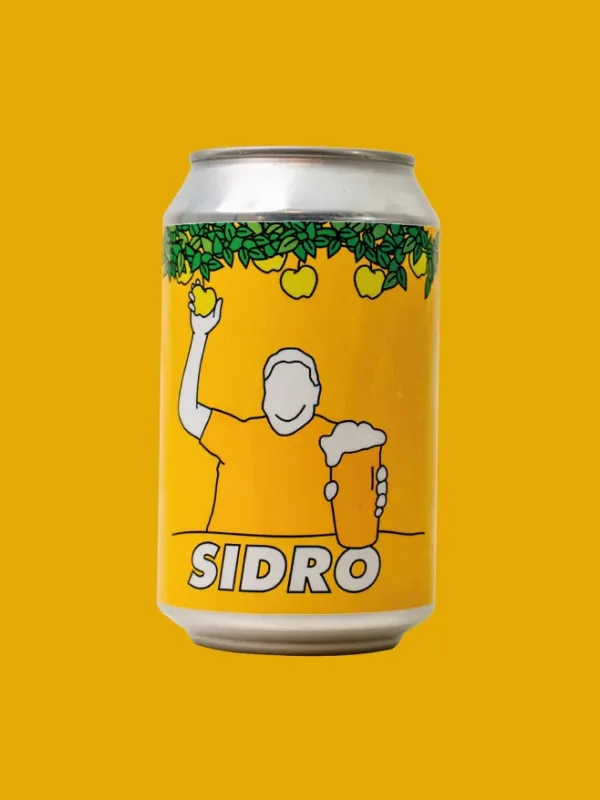
The journey to becoming an agricultural brewery began in June 2018 when Simone, Birrone’s brewer, made an extraordinary discovery. During a high-level brewing experiment involving a spontaneous fermentation of cherries inoculated into clean wort of Punto G, a true magic happened. The very long and slow sugar release from the cherries created a thin layer of puree on the wort’s surface which, upon analysis, revealed an unknown yeast strain that later became the property of Birrone. This yeast is unique — born from fruit and developed in beer wort, it immediately proved exceptional for beer fermentation. But it showed even greater wonders in fruit fermentations, especially in apple juice. This special yeast, kept in cryogenic storage, gives us fantastic sensations with each fermentation. It leaves a notably high residual sugar in the cider, which sets it apart from the classic stereotype. As a result, our cider is dry and aromatic, with a low alcohol content, and every sip gives the sensation of entering inside the apple. The agricultural brewery project was born from this first experience, but it evolved thanks to the awareness that the agricultural world and nature would gift us countless new experiences over the years. Since January 1st, 2020, Birrone has officially become an Agricultural Brewery.
2016 – GLUTEN FREE PROJECT
La Maranella is a historic beer in the Birrone family. It was born in 2009 as a Corn Ale brewed with Marano corn for the Marano Corn Festival. The organizers at the time — who later became colleagues in the agricultural brewery project starting in 2020 — were all producers of Marano Corn.
This small, red ear of corn is an excellence in polenta production. They wanted it to also become a key ingredient in the beer produced for the festival.
What was needed was a beer good enough to be enjoyed all day long, either on its own at any hour or paired with polenta-based dishes during the October celebration.
Thus, this top-fermented beer was born, with an orange hue like the corn kernels and an elegant, characteristic aroma. Containing 20% Marano Corn, it naturally became Birrone’s gluten-free beer choice. Corn is naturally gluten-free.
To achieve a beer that “tastes like beer,” the remaining 80% is made with barley malt (not millet, sorghum, rice, or other grains that can make beers undrinkable), and the gluten is removed. Gluten is a protein, and beer is rich in proteins.
At the end of fermentation, we add a protein fining agent that causes proteins to become heavier than the finished beer, making them precipitate to the bottom of the tank. The brewer then purges the tank from the bottom, eliminating gluten along with much of the other proteins.
In this context, the figure of Miss Maranella was born — personified as a young, health-conscious woman with copper-colored hair like the Marano corn kernels. She becomes the love rival of Miss Punto G, the eternal girlfriend of Birrone’s little man. Miss Maranella is elegant and lively, subtly entering the historic relationship of Birrone’s little man.
For this gluten-free beer, we chose batch certification rather than system certification. Each batch is analyzed, and the corresponding report is available on the label through a specific QR code, both on kegs and bottles.
2015 – HEAVEN & HELLO HELL & HEAVEN PROJECT
The 2015 educational project had a dual purpose. To definitively help the general public understand the difference between top and bottom fermentation, and to let Simone, Birrone’s brewer, experiment for the first time with the use of spices.
The chosen reference style was Blanche, but with the defects of traditional Blanche eliminated, to become a beer in the “Birrone – THE beer to drink” range. No sugar, as per Belgian tradition, and no classic spice blend, aiming to avoid the “decoction effect” found in some industrial Blanches.
The project was clear: two identical brews with aromatic extraction of spices at low temperature — one top-fermented and one bottom-fermented.
The evocative name chosen called upon Hell and Heaven, leaning more towards Heaven.
The 2015 inspiration brought great results, as Heaven & Hello Hell won the gold medal at the Beer of the Year competition.
But the greatest satisfaction was that, according to many, the best beer was Hell & Heaven, which unfortunately didn’t fit into any competition category.
Heaven went into regular production at Birrone, while Hell & Heaven remains close to our hearts.
2013 –SPONTANEOUS FERMENTATION PROJECT
Simone is a brewer who makes beers “based on his own desires,” and during that time, his desires were many—so much so that he experimented in every brewing sector: top-fermentation, bottom-fermentation, barrels, fruit, dry hopping, and more.
But the great passion of 2012 was to discover the world of spontaneous fermentations. Even better, “spontaneous fermentations with fruit.” These are special beers fermented thanks to wild yeasts naturally present on the fruit’s skin.
Countless experiments led to choosing cherries as the perfect fruit for this “toy.” Their notes marry perfectly with the wort of our Punto G.
Over the years, many new spontaneous fermentation “toys” followed, with all kinds of fruit: apples and pears, pineapple and kiwi, prickly pear, mango and papaya, and many more. But the love for cherry has been the most enduring.
Later on, this passion would lead us to the Cider project and the transformation into an agricultural brewery.
The magic lies in the fact that just a few kilograms of cherry mash can impart aroma to 800 liters of Punto G wort, which is already particularly flavorful by itself.
In the 2012/2013 edition, Lola went on to win a medal at the Beer of the Year competition thanks to its slightly winey notes given by a short barrel aging. It was a perfect example of a Flemish Red Ale.


